
I just entered a trade on IBIT (the Bitcoin ETF), and I want to walk you through exactly why I did it, how I priced it, and — most importantly — what my plan is if I'm wrong.
I bought the IBIT June 2028 $20 call and paid $22 for it. It's a deep in-the-money LEAP with a delta of 88, which means it moves almost point-for-point with the underlying.
So why a LEAP instead of just buying the stock?
Here's where it gets interesting. If I buy stock outright, I'm paying $36.50 per share and my downside risk is... well, all of it. With this LEAP, my max loss is capped at $22 — the premium I paid. That's my entire risk, defined from day one.
My breakeven is $42 (strike price + debit), which is about 15% above the current price. So yes, I'm giving up 15% of upside compared to owning stock. But in exchange, I'm getting significantly reduced risk and a lot more flexibility.
Now let me show you why the flexibility piece is so powerful.
What if I'm wrong on the entry? I think Bitcoin could realistically dip into the $40s. If that happens and I own stock, I just sit there and take the hit. But with this LEAP, I can actively improve my position.
|

Here's my repair strategy: If Bitcoin drops, I can roll my $20 call down to the $15 strike. My rule for rolling? I'll do it when I can roll for 30% of the width of the spread. This spread is $5 wide, so 30% = $1.50. I'd even stretch to $1.60.
Watch what that does to my breakeven: My original breakeven was $42. If I roll down for $1.50, my new breakeven shifts to the $15 strike + $23.50 (original debit + roll cost) = $38.50. That's a dramatic improvement.
What about time? Right now the furthest expiration I could buy was June 2028. But in the near future, the December 2028 expiration will become available. If this trade moves against me, I can roll down in strike and out in time — giving myself more room to be right.
So let's compare side by side:
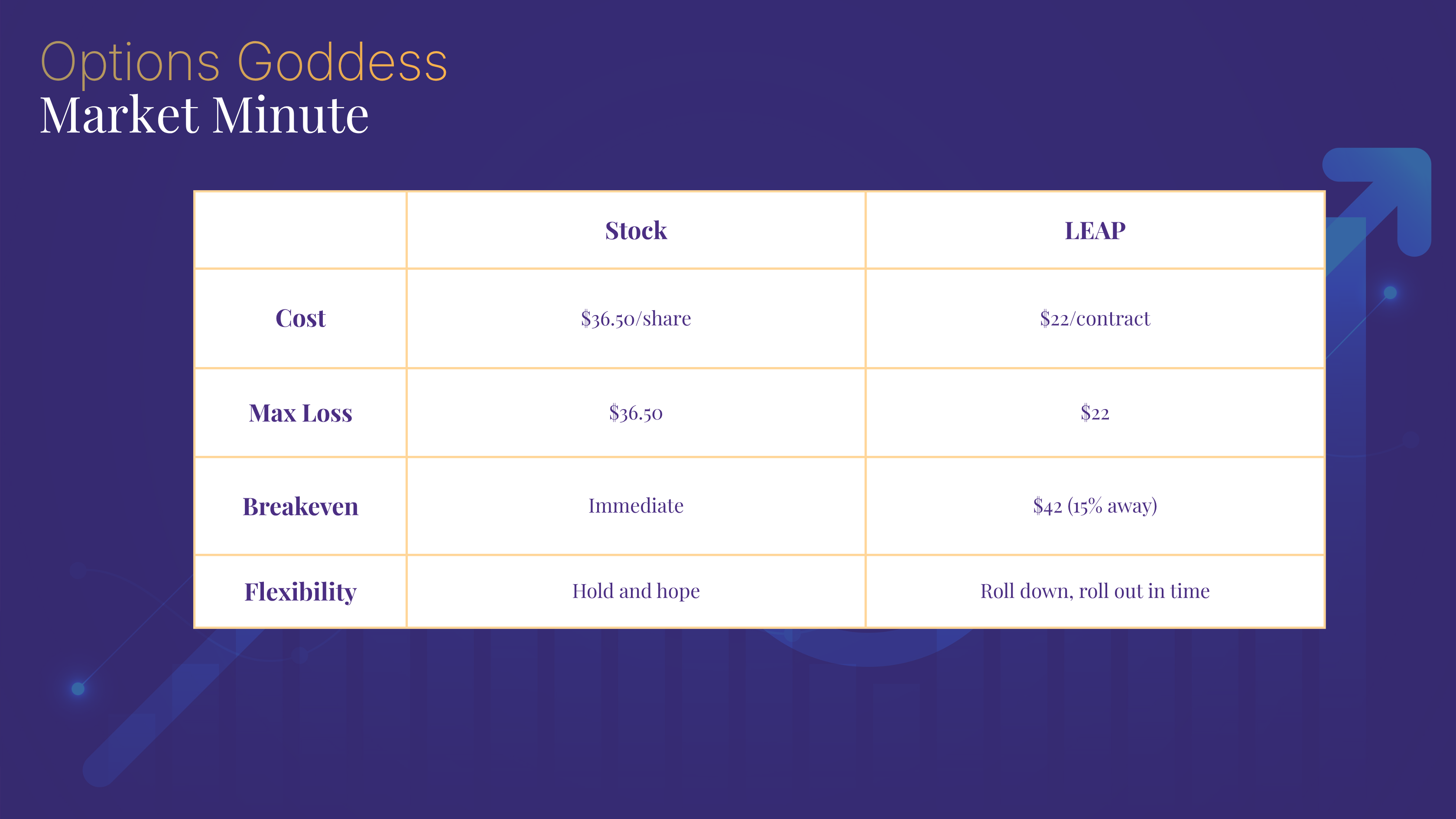
The options side gives me so much more flexibility. Yes, I'm giving up 15% upside, but my cash outlay is $22 versus $36 (or $18 on margin). And I have a built-in repair strategy from the moment I enter.
This is how I process decisions and why I make the choices I do. It's always about managing risk first and giving yourself room to adjust.